What workshop teams usually need before growth starts
Most small production teams do not struggle because they lack skill. They struggle because the work is moving faster than the systems around it. One week it is a custom furniture run in Johannesburg, the next it is signage, metal brackets, laser-cut pieces or small-batch product assembly for a client in Cape Town. The machine set may be sound, but the team still needs better pricing, clearer handovers, and people who can answer honest questions without acting clever.
That is where peer contact matters. Workshop teams benefit from meeting others who have already worked through supplier delays, power cuts, shared-tool scheduling and client payment delays. A good network gives you a place to compare notes on process, not just show finished work. It also helps makers see how their own output fits into bigger opportunities across South Africa and into Nairobi, Durban or Pretoria through online sessions and chapter meetups.
Typical equipment and production set-ups we see
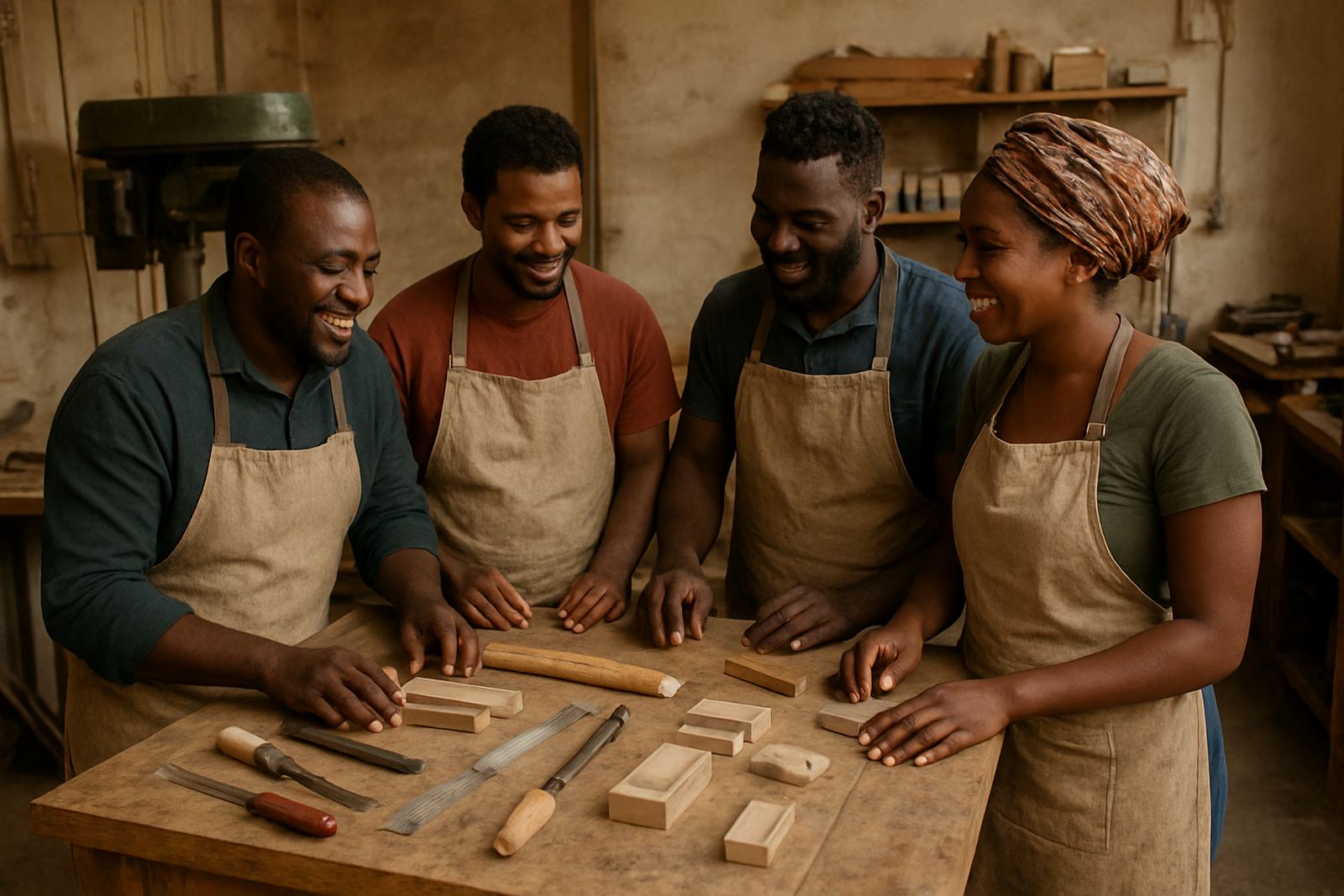
Every workshop is different, but many small teams work with a similar mix of tools and benches. The setup often includes a cutting area, assembly tables, storage for sheet material or offcuts, and a packing corner. In some cases there is a sewing or finishing room, in others a simple fabrication bay with welding, drilling and sanding equipment. Even a compact space can work well if the flow is planned properly.
- Hand tools, clamps and measuring gear
- Benches or work tables with enough clearance for two people to pass
- Power tools, cutting tools, or a small machine station
- Labelled storage for stock, fasteners, offcuts and finished pieces
- Basic packing materials, scales and dispatch shelving
Teams in coastal areas like Durban or Cape Town also need to think about humidity, rust protection and storage that keeps materials off the floor. In Johannesburg, dust control and safe cable runs matter more than many people expect. Load-shedding means battery backup, inverter planning or a generator may be part of the set-up, depending on the machines involved.
Layout planning that saves time on busy days
A workshop layout should reduce walking, lifting and confusion. If a team member has to cross the room five times to finish one order, that is wasted time and more chance of mistakes. Keep the process in one direction where possible: intake, prep, production, checking, packing. For teams working on repeat orders, this matters even more because one bad layout can slow every job after that.
Start with the heaviest movement first. Put raw materials close to the cutting or prep area. Keep packaging near dispatch. Separate clean work from dusty work if the team handles finished items, samples or client-facing pieces. In shared spaces, a clear floor plan also helps with safety and with municipal or landlord requirements around access, fire exits and noise. It sounds basic, but many teams only fix the layout after a near-miss or a failed inspection.
Practical planning also includes people. Not every team member should be doing everything at once. A better system is to assign who receives material, who checks measurements, who approves the final item and who handles client handover. That reduces confusion, and it saves money.
Common mistakes small production teams keep repeating
Most of the mistakes are not dramatic. They are the quiet ones that eat into margin. Teams underquote because they forget consumables. They buy the right machine but no spare parts. They store materials in a way that causes damage, then pass the cost to the next order. They also underestimate how long setup and finishing takes, especially when clients want changes at the last minute.
- Pricing only for labour and forgetting waste, transport and rework
- Keeping no record of batch sizes, supplier lead times or repeat faults
- Mixing client samples with live stock
- Overcrowding the space so teams cannot move safely
- Skipping a final check before packing or delivery
There is also the partnership side. Many workshop teams avoid talking openly about capacity because they fear losing work. In practice, the opposite is often true. If you can say exactly what you can produce, when you can produce it and where you need support, it becomes easier to find collaborators who can fill the gap instead of causing one. A bit of honesty saves a lot of embarassment later.
Budget ranges in Rand for a lean but workable set-up
Budgets vary widely depending on what is being made, but many small teams in South Africa start with a practical range rather than a perfect one. A lean shared set-up for a few people can begin around R80 000 to R200 000 if the space is already secured and the equipment list is tight. A more complete production space with better finishing, storage and backup power can move into the R250 000 to R600 000 range. Once specialised machinery or custom extraction, electrical work and safety upgrades come in, the number can climb beyond that.
It helps to budget in layers: essential tools first, then safety and backup power, then storage and workflow improvements. Do not forget rent deposit, materials float, insurance, and the cost of moving work in and out of the space. If you are working from Braamfontein, Newtown or Soweto, local access and transport costs may be lower than outsourcing everything, but your cashflow still needs room for delayed payments and unexpected repairs.
How PioCreat Africa supports workshop teams across the network
PioCreat Africa gives workshop teams a place to meet peers, test ideas and find people who understand the realities of making in South Africa and across the continent. Through Braamfontein chapter meetups, showcases, mentorship circles and online collaboration calls, teams can share methods, ask for feedback and make contacts that are more useful than a casual follow on social media.
Support for workshop teams can include showcase curation, portfolio feedback, mentor matching, event production, creator photography, product styling, collaboration facilitation, pricing support, market readiness, community partnerships, online session hosting and creator profile writing. For a small fabrication or production team, that can mean better presentation for buyers, clearer pricing for commissions, and stronger links with other makers who can assist with a specialised stage of the process.
If your team is based in Pretoria, Durban, Cape Town, Nairobi or right here in Johannesburg, the aim is the same: build practical ties, learn from people doing the work, and keep the operation steady enough to grow.