

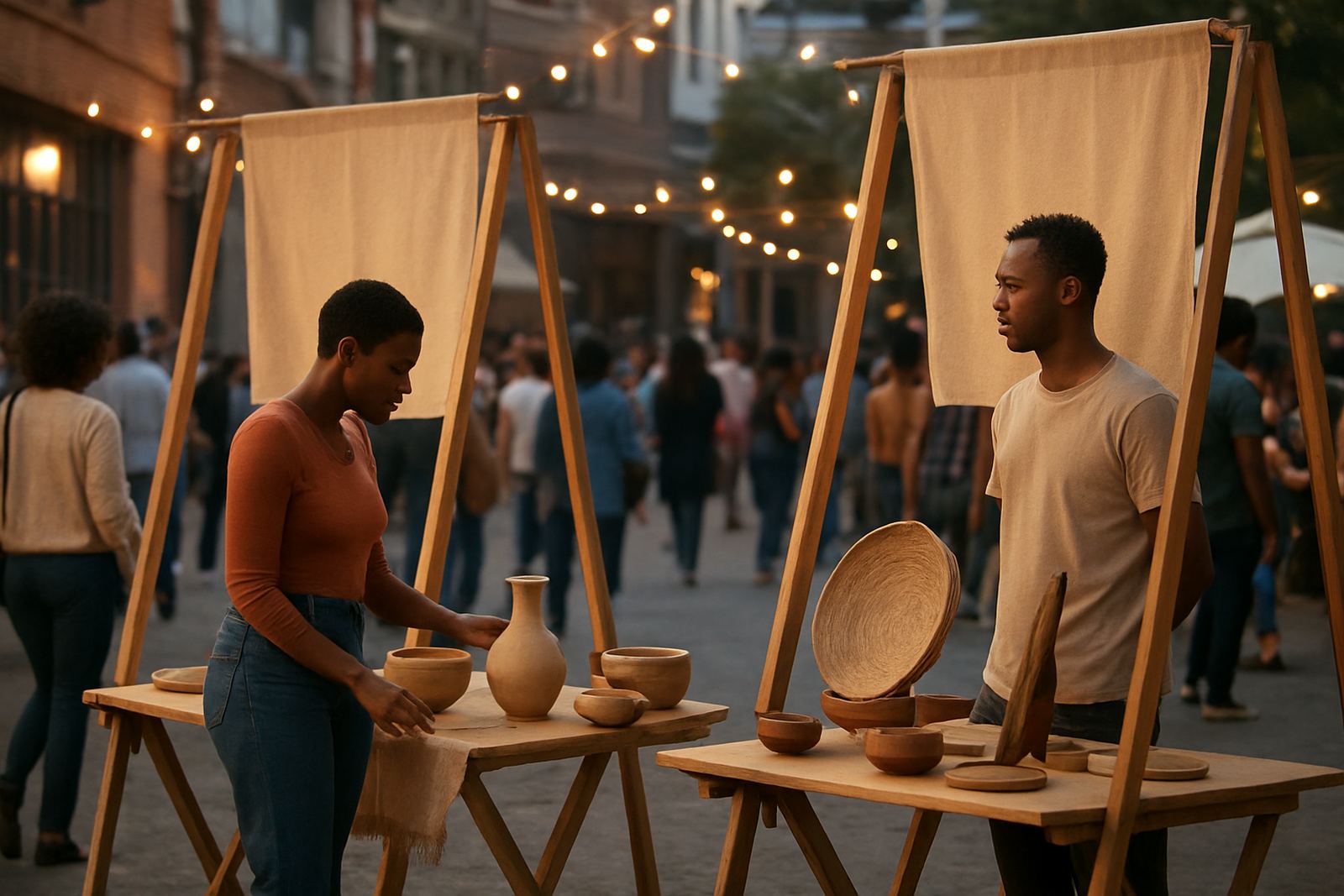
What the Festival Pop-Up Series is for
This series is built for short-term showcases that need presence without a permanent build. Think arts festivals, design weekends, township activations, heritage events, student markets and city-centre public programmes where visitors move fast and attention is earned in seconds. The format gives makers and project teams a clean, visible space for products, demos, samples and conversations, with enough structure to keep everything organised when the crowd builds up.
In Braamfontein, Rosebank, Newtown or along a busy promenade in Cape Town or Durban, the biggest challenge is usually not the display itself, but the pace around it. People stop, ask questions, take photos and move on. A festival pop-up needs to hold together through all of that, with clear sight lines, safe access and a layout that works even when the space is tight.
- Short-run showcase events tied to festivals, holidays and public programmes
- Suitable for product launches, sampling, creator stalls and collaboration points
- Works for indoor halls, covered walkways, courtyards and outdoor civic spaces
Sizes and layout options that make sense on the day
The standard formats are designed around the kind of footprint most event organisers can actually allocate. Smaller setups work well for a single creator or a focused product range. Larger layouts suit a shared showcase with multiple exhibitors, a styling zone, or a demo counter with room for photography and customer flow. If your team expects queues, you need more depth than you think, and a clear back-of-house strip for stock, water and packaging.
Common configurations include compact 2 m x 2 m bays, mid-size 3 m x 3 m stands, and shared 6 m x 3 m showcase runs for grouped presenters. Height is usually kept within venue rules, often around 2.4 m to 3 m depending on roof clearance, wind exposure and municipal or festival conditions. For markets in exposed areas, side bracing and weighted bases matter more than fancy finishes.
- 2 m x 2 m for a single maker or tight venue footprint
- 3 m x 3 m for a fuller product range and one staff member inside the stand
- 6 m x 3 m for joint showcases, mentorship demos or multi-brand display zones
- Optional lockable storage crate, counter unit, pegboard wall or literature rail
Where it suits best across South Africa and the continent
This format suits places where people gather for culture, shopping and conversation. It works well at music and arts festivals, public holidays, design fairs, campus events, tourism activations and weekend city markets. It also fits creator communities running showcase moments in Johannesburg, Pretoria, Durban and Cape Town, plus regional sessions in Nairobi or online-linked hybrid events where the physical activation is paired with digital promotion.
At coastal sites, humidity can affect printed material, adhesives and packaging. In summer, you also need shade and airflow or products start to look tired before midday. In Gauteng, dust and high foot traffic are the bigger concern. For township and street-facing events, the stand must be easy to clean, easy to pack down and strong enough for repeated transport in a bakkie or trailer, without taking a knock on every move.
- Festival grounds and cultural weekends
- Mall forecourts, heritage precincts and civic squares
- Campus markets, creator exhibitions and public workshops
- Hybrid programmes where in-person visibility supports online reach
Installation, power and gas requirements
Setup depends on the venue and what the stand is doing. A simple showcase with shelving and lighting can often be handled with a small crew and a standard municipal or venue power point. If you are adding live making, food prep or heating, the rules become stricter and the organiser may need to see an electrical layout, gas certificate or fire plan before approval. Most event spaces will also want to know about cable runs, trip hazards and whether the stand can be isolated after hours.
For power, plan for 1 to 2 dedicated circuits for lighting, charging and small display equipment, with cable management that keeps leads off the ground. Battery backup is useful where load-shedding or unstable supply is part of the day, especially for point-of-sale devices, lights and camera charging. Gas is only for approved equipment and only where the venue allows it. Cylinders must be secured upright, kept outside the main footpath and inspected before use.
- Typical power need: 220V mains supply, 1 to 2 circuits depending on the setup
- Lighting load: low to moderate, usually LED based for heat control and longer run time
- Gas use: only if cooking or heat display is part of the approved programme
- Setup time: allow 2 to 4 hours for a basic stand, longer for grouped or branded builds
Care, servicing and pack-down between events
Festival equipment needs regular cleaning because dust, rain spray, food marks and handling are part of the job. Wipe display surfaces after each event, check fasteners and replace any worn cable ties, clips or adhesive strips before the next booking. Printed panels and signage should be stored flat or in protective sleeves, not folded into the back of a car and forgotten there for a week. If the stand was used in wet weather, dry everything properly before packing away or you will get stains, swelling and smells that are hard to remove.
Servicing should also include a quick check on wheel locks, weighted feet, hinge points and any electrical plugs or adaptors. In the run-up to a busy festival season, it pays to test the whole kit once at base rather than discovering a fault on site at 7 am when the gates are already opening. A practical servicing routine keeps the series ready for repeat use and helps avoid damage that looks small now but becomes expensive later.
- Clean after every event and dry fully before storage
- Inspect lights, plugs, hinges, wheels and support points before dispatch
- Keep a spare kit of clips, tape, ties and cleaning cloths
- Store in a dry, shaded space to protect graphics and timber finishes
What to confirm before you book a pop-up slot
Before confirming a Festival Pop-Up Series booking, check the event date, venue access times, floor surface and the exact footprint available to you. Ask whether there is overhead cover, secure access for loading, and any rules about generators, open flame, gas or amplified sound. If the event is outdoors, also confirm wind exposure and whether the organiser requires weighted bases, fire-retardant materials or rain covers. A good brief saves a lot of back and forth.
You should also decide who is staffing the stand, what stock is going on display, and whether you need help with creator photography, product styling or profile writing for the activation. If the purpose is sales, make sure you know how many units need to fit on the table without crowding the space. If the purpose is visibility, leave room for standing conversations and quick photos. The best pop-up is the one that looks neat at 10 am and still looks presentable at 4 pm, even after a long day and a bit of weather.
- Venue dimensions and access times
- Power availability, generator rules and load-shedding backup
- Need for shade, rain protection or weighted bases
- Stock volumes, staffing count and any product demo needs
Key facts
| Product type | Temporary showcase system for festivals, markets and public cultural events |
|---|---|
| Standard footprints | 2 m x 2 m, 3 m x 3 m, 6 m x 3 m shared layout |
| Height range | About 2.4 m to 3 m, subject to venue rules and wind conditions |
| Power requirement | 220V mains, usually 1 to 2 circuits for lighting and charging |
| Optional utilities | Approved gas use only where permitted, plus battery backup for outages |
| Best use period | One-day to multi-day activations with quick pack-down and repeat setup |