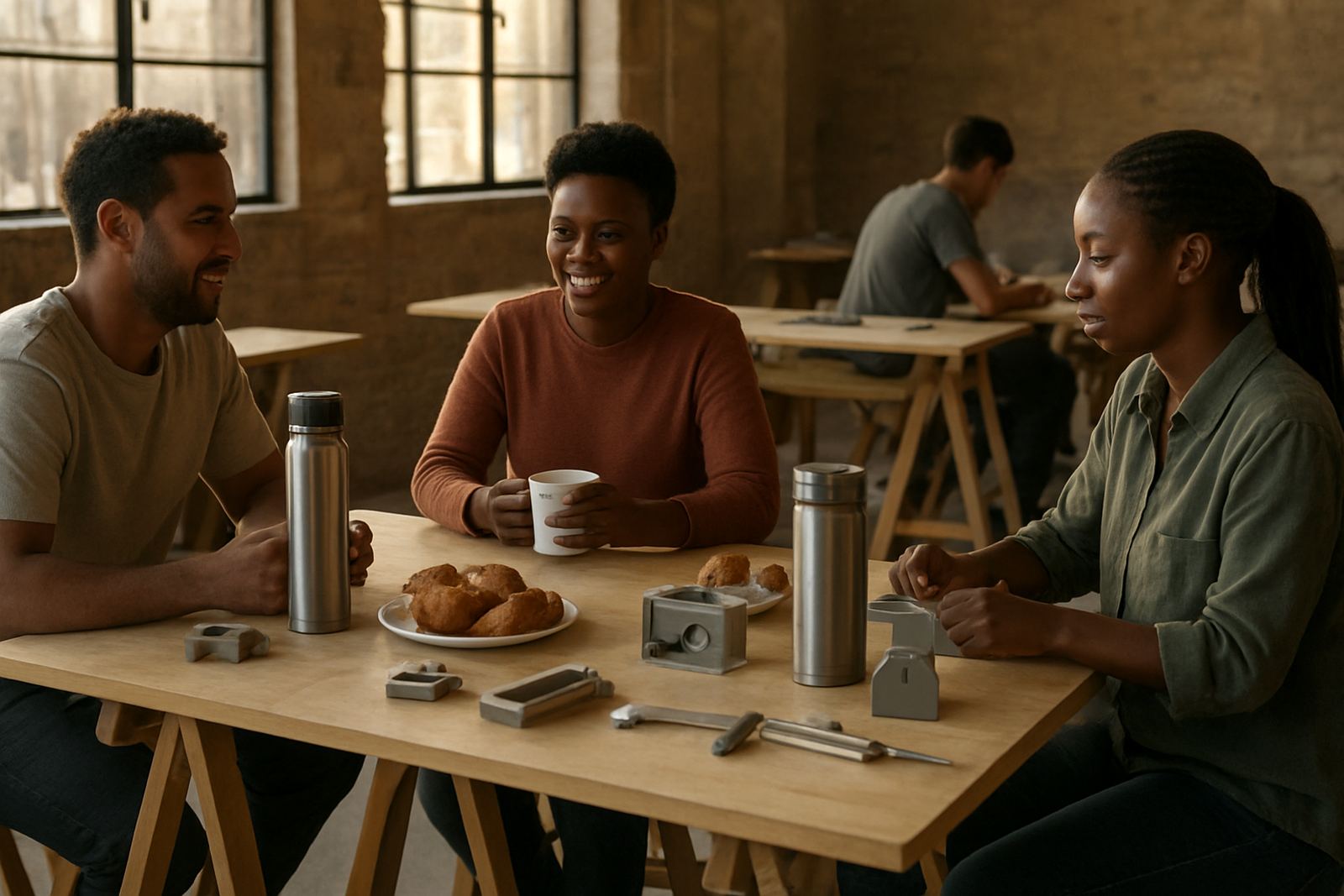
What Builder Breakfasts Are For
Builder Breakfasts are early sessions for people who work with their hands and need straight answers. Think small workshop owners, fabricators, product makers, joiners, metal teams and design-led manufacturers comparing how they cut, weld, finish, pack and price. The tone is practical, not formal. You arrive with a problem, a process issue or a half-tested idea, then leave with notes you can actually use in the workshop by Monday.
Each breakfast is shaped around a single production theme so the discussion stays useful. That might be material choice, batch consistency, supplier pressure, lead times, or how to keep quality steady when orders start growing. Sessions are also good for teams that need to meet other makers in Johannesburg, Pretoria, Durban, Cape Town, Nairobi and online without wasting a full workday.
- Peer learning for workshop teams and fabricators
- Short talks, open discussion and Q and A
- Useful for product makers, build teams and small manufacturers
- Best for sharing methods, not sales pitches
Sizes, Formats and Booking Options
Builder Breakfasts are usually held in small groups so everyone gets time to speak. The usual format is 12 to 30 people, which works well for active discussion and hands-on problem solving. Larger sessions can be arranged for chapter meetups, partner venues or showcase weeks, but the smaller format is better when the topic needs detail.
There are a few booking options depending on what your team needs. Some groups want a single topic breakfast with a guest maker or mentor. Others prefer a monthly circle where the same people share progress updates. We also run mixed sessions where workshop teams and designers meet in the same room, which helps when production and product development need to line up. That kind of session often surfaces small issues early, like an over-complicated cut list or a finish that is too costly to repeat.
- Small circle: 12 to 15 people
- Standard breakfast: 16 to 30 people
- Chapter session: 30 to 60 people
- Hybrid option with online attendance for remote teams
Where Builder Breakfasts Suit Best
These sessions suit places where making happens for real. That includes maker spaces, workshop yards, shared production rooms, creative studios and community halls with enough tables and chairs. In Braamfontein and Newtown they often work well as a weekday morning session before the city gets too busy. In Pretoria, Durban and Cape Town, they can sit neatly between early production and midday deliveries. Online sessions suit teams working across provinces or across borders who need a clean way to keep people in the same conversation.
They are especially useful when a business is trying to move from informal production to repeatable output. If your team is handling furniture, signage, product assembly, fabric work or light fabrication, the breakfast format helps because it is short enough to keep attention but long enough to get into the detail. It also suits teams affected by load-shedding, because the session can be planned around the morning power window if required.
- Workshop yards and maker spaces
- Shared studios and production rooms
- Community halls and partner venues
- Online for multi-city and cross-border teams
Setup, Power and Catering Requirements
Most Builder Breakfasts need very little setup. A quiet room, chairs, a table for notes and enough light are usually enough. If the session includes product handling or live demos, allow extra table space and a clean surface for samples. For in-person gatherings, an area that can seat people in a half-circle works better than a long boardroom layout, because people can see each other and speak more freely.
For power, you only need basic supply if you are using a kettle, projector, microphone or charging points for laptops and phones. If the venue is affected by load-shedding, please check whether a backup inverter or generator is available. Gas is not usually needed unless the breakfast includes live cooking or a demo that requires it. Keep the catering simple so the focus stays on the session. Tea, coffee, water and a light breakfast are enough for most groups.
- Room with chairs and table space for notes
- Basic mains power for audio, screen or charging
- Backup power helpful for load-shedding mornings
- Gas only needed for cooking or special demo setups
Care, Servicing and Follow-Up
A Builder Breakfast works best when the notes do not end up in a drawer. After each session, the useful part is the follow-up. That can be a summary of the main issues, a list of recommended changes, or a short action plan for the workshop team. If a group is meeting monthly, keep the same structure so progress is easy to track. If the topic changes every time, send out the agenda early so people arrive with the right questions.
There is little maintenance on the session itself, but the venue and the materials need attention. Keep sample items clean, label all tools or parts used in demonstrations, and check that the room is reset after each breakfast. If the group is doing creator photography or product styling alongside the discussion, make sure items are ready before people arrive. A bit of order saves time and avoids confusion, which sounds simple but makes a big difference.
- Send a short summary after the session
- Keep recurring sessions on a steady schedule
- Label samples, tools and notes clearly
- Reset the room before the next group arrives
What to Check Before You Book
Before booking a Builder Breakfast, work through the practical details first. Know the main problem you want to solve, the number of people coming, and whether the group needs an open discussion or a structured talk. If you are inviting people from more than one chapter, allow for travel time and start early enough for job site schedules. A 7:30 or 8:00 start often works well for makers who need to get back to the floor by mid-morning.
It also helps to check the venue rules, the noise level and whether food can be served on site. If your group wants photography, portfolio feedback or a short showcase segment, say so when booking. That way the session can be planned with the right layout and enough time. When in doubt, keep the brief tight. A clear topic gets better answers than a broad one, and it saves people from talking past each other.
- Main topic or production challenge
- Number of attendees and chapter mix
- Venue access, parking and timing
- Need for power, screen, Wi-Fi or catering
Key facts
| Session length | 90 to 120 minutes |
|---|---|
| Group size | 12 to 30 standard, larger by arrangement |
| Format | In person, hybrid or online |
| Power needs | Basic mains supply; backup power recommended during load-shedding |
| Gas needs | Only if cooking or a live demo requires it |
| Best use | Production problem solving, peer learning and maker networking |